Jesus’ command elicits a crisis of faith (Matthew 8:18)

Matthew 8:18

Jesus commanded them “to go over to the other side (Matthew 8:18).” This command elicited a crisis of faith for many of those who started following him. Crossing the Sea of Galilee required a multi-day trip on the sea. Whatever plans they may have made for the next few days would need to be set aside. Whatever responsibilities they had they would need to make other arrangements for. Furthermore, the territory to which they were going was primarily Gentile territory, a loose confederation of Hellenistic city-states that few Jews would travel to. Jesus’ command created a crisis of for many who gathered around him that day.

Continue reading
Cultural Christianity cannot save; only Jesus can do that (Matthew 8:5-13)

Matthew 8:5-13

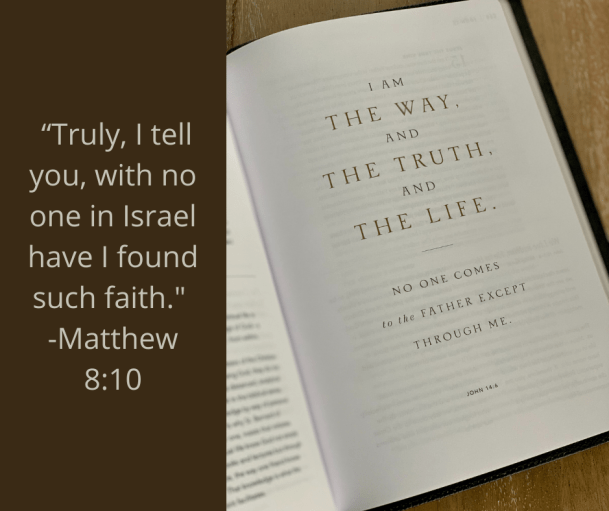
Matthew originally wrote his Gospel Account primarily for the Jews of his day (in biblical studies we call this the author’s original intended audience). He fills his account with Old Testament citations and presumes an awareness of Jewish culture that other Gospel writers need to spell out for their original audiences.

For this reason, it may seem odd that Matthew, at times, seems to anathemize his fellow Jews. One startling example occurs in Matthew 8:5-13. There Matthew records Jesus saying that a Roman Centurion’s faith surpasses the faith of anyone in Israel. Then he tells us Jesus said: “I tell you, many will come from east and west and recline at the table with Abraham, Isaac, and Jacob in the kingdom of heaven, while the sons of the kingdom will be thrown into the outer darkness. In that place there will be weeping and gnashing of teeth.”

Continue reading

Hope in the hallelujah chorus of heaven (Revelation 19:1-2)

Revelation 19:1-2

God wrote a song which his people will sing at the consummation of the age, “Hallelujah! Salvation and glory and power belong to our God, for his judgements are true and just; for he has judged the great prostitute who corrupted the earth with her immorality, and has avenged on her the blood of his servants (Revelation 19:1-2).” (It might help to know that the great prostitute here symbolizes all that opposes God’s good and gracious reign on earth.)   

We long for that day when all who hope in Christ see their hope crystalized. Are we not surrounded by death all day long? Mourning? Pain? Bitterness? Do not our own psychological and emotional well-being attest to our longing for a better world, the happy ending to which all happy-endings point? We long to say words like those that one of the characters in C.S. Lewis’s Narnia exclaims: “I have come home at last! This is my real country! I belong here. This is the land I have been looking for all my life, though I never knew it till now.”

Continue reading

The answer to unanswered questions (Job 41:11)

Job 41:11

In H.G. Well’s novel The War of the Worlds, Martians invade the earth. Despite humanity’s greatest devices and efforts, it seems the Martians will win and ravage the earth and all humanity. However, at the eleventh hour, the unexpected happens. The Martians die, but not because of any effort of humanity. It turns out that the bacteria on earth that the Martians had been ingesting through their eating and drinking during their stay on earth wreaks havoc on their systems. The narrator goes on to say, “Martians—dead!—slain by the putrefactive and disease bacteria against which their systems were unprepared; […] slain, after all man’s devices had failed, by the humblest things that God, in his wisdom, has put upon this earth.” Then the narrator lifts his hands and gives thanks to God.

God’s wisdom exceeds our wisdom. Through science and discovery, humanity has learned much. Nevertheless, if you compared the mass of knowledge accumulated by humanity over the ages with God’s infinite knowledge, humanity’s knowledge, relatively speaking, could be stored on the head of a pin, with room to spare.

Continue reading

The better Nazarite (Numbers 6:1-21)

Numbers 6:1-21

Nazarites were supposed to be holy. Samson was not.

When Samson was a boy his mother dedicated him as a Nazarite. Nazarites were not suppose to drink or eat anything that came from the grapevine. They were not allowed to have a razor touch their head. They were not to go near the dead.

Continue reading

“Vengeance is mine,” says the Lord, Part 1 (Deuteronomy 32:35)

Deuteronomy 32:35

If you want to know God as he has revealed himself to us in Scripture, you need to hold together his justice and his love. These are not two different sides of God, as if God is a split personality like Dr. Jekyll and Mr. Hyde. Nor are these two different ways that God has dealt with his people throughout history, so that in the Old Testament he was all fire and judgement but in the New he is all love. 

God has always been and always will be both just and loving toward us. At best, we can say love and justice are two different aspects of the same God, but one aspect never exists apart from the other. God does not have good days and bad days like we do. He does not wake up on the wrong side of the bed some mornings. He does not get hangry.

Continue reading

Let us not roll up our window and drive away (Deuteronomy 30:11-14; Romans 10:5-13)

Deuteronomy 30:11-14; Romans 10:5-13

A well-known Youth Minister once told the story of the year his youth group decided to forgo their usual annual carwash fundraiser and instead offer car washes for free to anyone who wanted one. It was intended to demonstrate God’s grace, which comes to us through no effort of our own.

During the event, a man drove up, rolled down his window, and asked the Youth Minister, “how much?” Pointing to the sign, the Youth Minister said, “It’s absolutely free.” “Oh, I know how this works, buddy,” the guy quipped, “you say it’s free but you really want a donation; how much do you want?” The Youth Minister repeated, “It’s free, because God’s grace is free.” The man rolled up his window and drove away.

Continue reading

God’s law to Moses was very gracious (Deuteronomy 30:11-14)

Deuteronomy 30:11-14

Let me test your Bible knowledge. This question ranks like a high cash-value question on Jeopardy. Did the law of Moses require the nation of Israel to be perfectly obedient to God? If you answered in the negative, you correctly answered this question.

Continue reading

A circumcision of the heart (Deuteronomy 30:1-10)

Deuteronomy 30:1-10

Why did God choose to make circumcision the covenant sign of Israel?

When people made covenants in ancient times, they often would perform a covenant sign to remind each other what would happen if either party broke the covenant. In the case of Israel – do not think too hard about this – God required every male Israelite to have a small, sensitive part of their body cut off. They were declaring that if the nation broke covenant with God through habitual disobedience, God, in his perfect justice, ought to cut them off from him, each other, and even life itself. 

Just as Israel habitually broke the covenant that God made with them through Moses, we all have disobeyed God’s holy law. God’s justice requires we be cut off. Yet, Jesus allowed himself to be cut off for our behalf, so that we would not need to.

Continue reading

What if you are found opposing God? (Acts 5:39)

The esteemed pharisee Gamaliel once warned, “You might even be found opposing God (Acts 5:39)!” Jesus’ apostles were on trial for teaching in the name of Jesus. The Jewish Sanhedrin was on the brink of sentencing them to death when Gamaliel made this bold assertion.

Many today do not give much thought about the implications of the existence of God. Undirected, evolution, while a widely fanciful idea, has convinced many that the world we live in no longer requires the intelligence of a designer for its existence. Meanwhile, the latest science shows us, with every discovery, how narrow the margin of error for life’s existence is.

Continue reading